
Explaining Vision Models via Game-Theoretic Indices
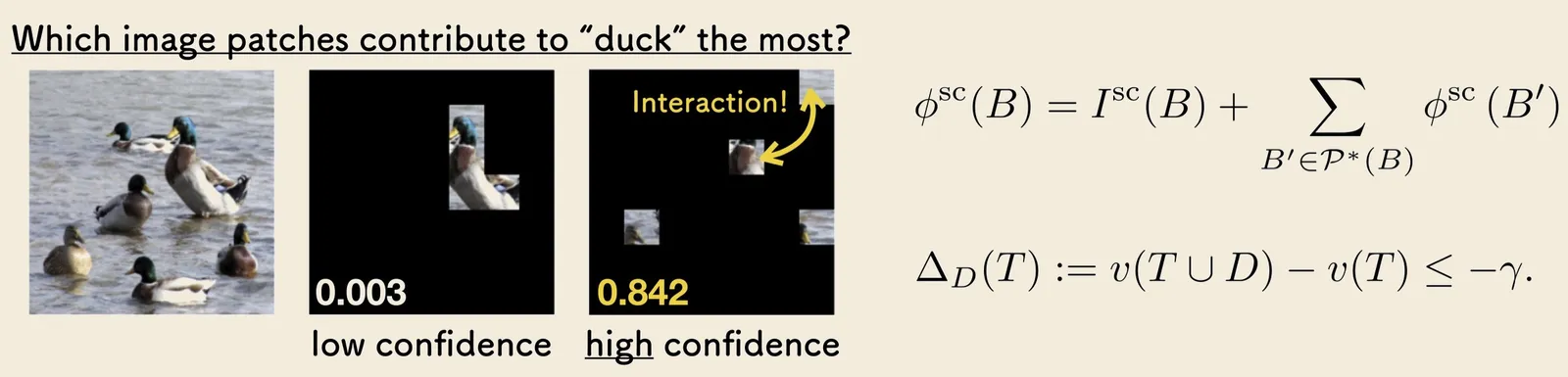
Deep vision models achieve high accuracy, but their decisions are often a black box. We use game-theoretic frameworks — Shapley values and related notions — to quantitatively analyze how different regions of an image (pixels or patches) jointly contribute to a model’s prediction.
Rather than scoring individual pixels in isolation, we treat a model’s decision as a “knowledge structure” that emerges from interactions between regions. We’re also investigating a subtler issue: averaging-based attributions like the Shapley value can systematically over-credit spurious “contextual distractor” groups depending on context. To address this, we study more robust, stability-based attribution methods grounded in concepts like the least-core.
Progress so far
We presented work on identifying important groups of pixels through game-theoretic interactions at CVPR 2024, and extended this to object detectors by explaining their predictions through the collective contribution of pixels. We’ve also formalized how Shapley values can over-attribute importance to contextual distractors, and proposed a more stable attribution method based on the least-core (ICML 2026 workshop).
Related Publications
* Corresponding author
Seeing Through Distractions: Stable Attribution via the Core
Sai Ganesh Nagarajan, Toshinori Yamauchi, Hiroshi Kera
International Conference on Machine Learning (ICML) Workshop, 2026
Explaining Object Detectors via Collective Contribution of Pixels
Toshinori Yamauchi, Hiroshi Kera, Kazuhiko Kawamoto
Meeting on Image Recognition and Understanding (MIRU 2025), 2025
Identifying Important Group of Pixels using Interactions
Kosuke Sumiyasu, Kazuhiko Kawamoto, Hiroshi Kera*
Meeting on Image Recognition and Understanding (MIRU 2024), 2024